For the past decade, enterprises have invested billions of dollars into conversational chatbots and virtual assistants, only to watch customer frustration soar. Built on rigid decision trees and brittle keyword matching, first-generation bots broke the moment a user deviated from a pre-scripted path. Even the initial wave of Large Language Model (LLM) copilots—while eloquent—were fundamentally passive, capable of answering questions but incapable of executing actions in corporate systems. Today, we stand at the precipice of a momentous technological leap: the rise of **Agentic AI**. Unlike passive chatbots, autonomous AI agents possess the cognitive architecture to reason through complex goals, orchestrate enterprise tools and APIs, and execute multi-step operational workflows with human-like judgment.
The Anatomy of a Failure: Why Traditional Chatbots Fall Short
To understand why Agentic AI is revolutionizing corporate operations, we must first examine why legacy chatbots failed to deliver on their transformative promises. Traditional conversational interfaces operate on deterministic, finite-state logic. When a customer reaches out with a nuanced, multi-part request—such as *"I need to change my shipping address on order #8492, but only if it hasn't shipped yet; otherwise, please cancel item B and issue a credit to my account"*—a traditional chatbot collapses into an endless loop of unhelpful clarification prompts.
Even basic RAG (Retrieval-Augmented Generation) chatbots are severely limited by their read-only nature. They can summarize a policy document or regurgitate a knowledge base article, but when required to interact with an underlying database—such as updating a record in Salesforce, triggering a refund in Stripe, or modifying a shipment in SAP—they hit a structural brick wall. The user is inevitably handed off to a human agent, who must restart the conversation from scratch.
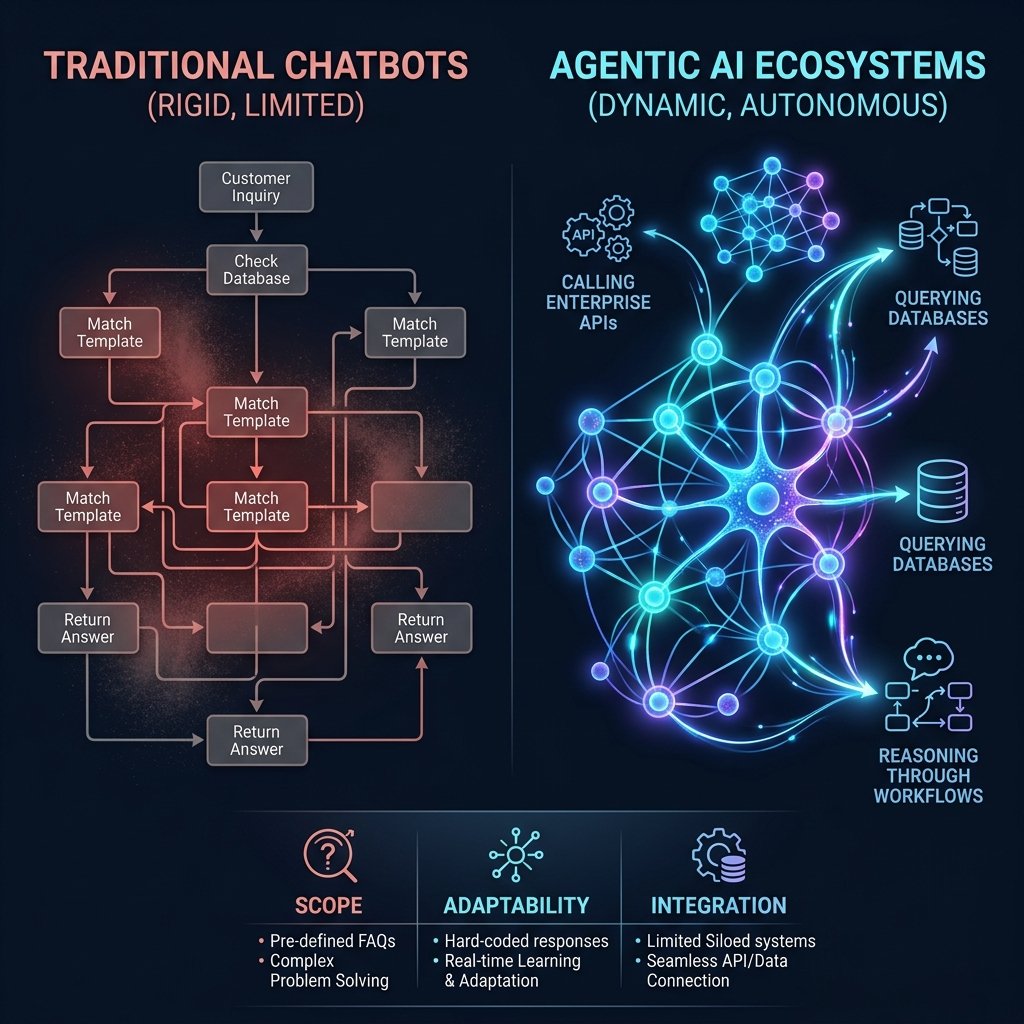 Figure 1: While traditional chatbots rely on brittle, linear decision trees (left), Agentic AI operates as a dynamic neural reasoning engine capable of orchestrating enterprise APIs and tools autonomously (right).
What is Agentic AI? The 3 Pillars of Autonomous Software
Agentic AI represents a fundamental shift from *conversational* software to *action-oriented* software. An AI agent is not merely a language model; it is an autonomous computational entity equipped with three defining capabilities:
🧠 Cognitive Decomposition
When presented with a high-level business objective, an AI agent autonomously breaks the goal down into logical, sequential sub-tasks. It formulates an execution plan, determines what information it lacks, and decides which tools to invoke.
🛠️ Tool & API Orchestration
Agentic models are granted secure, permissioned access to your enterprise software stack. They can execute SQL queries, call REST APIs, send emails, generate PDF contracts, and update CRM records with mathematical precision.
🔄 Self-Reflection & Retries
If an API call returns an error or a database query yields unexpected results, an agent does not crash. It evaluates the error code, adjusts its syntax or parameters, and retries the operation—exhibiting genuine cognitive resilience.
Human-in-the-Loop (HITL) Orchestration: The Rocket AI Architecture
While autonomous agents are capable of executing complex workflows, enterprise governance requires absolute reliability and accountability. At **Rocket AI Services**, we pioneer a **Human-in-the-Loop (HITL) architectural framework** that merges the lightning-fast processing power of Agentic AI with the empathetic judgment of our bilingual nearshore specialists in Bogota and Miami.
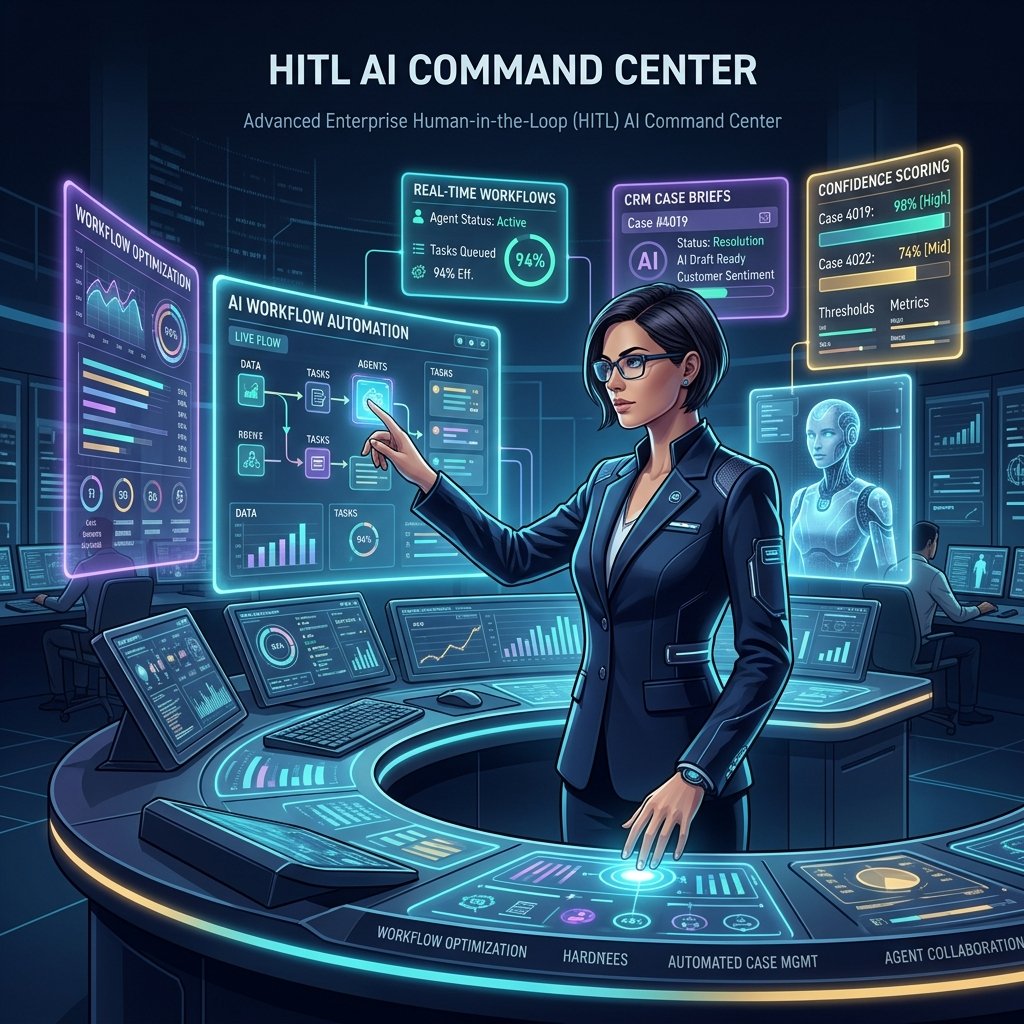 Figure 2: In a Human-in-the-Loop architecture, autonomous digital agents handle thousands of routine transactions in milliseconds while routing high-stakes exceptions to human specialists.
Under our hybrid orchestration model, workflows are categorized by risk and complexity:
- Tier-1 & Tier-2 Autonomous Execution: High-volume, standardized tasks—such as password resets, order tracking, invoice reconciliation, and address updates—are executed 100% autonomously by AI agents in milliseconds, with zero human intervention.
- Confidence Threshold Routing: Every decision made by an AI agent is accompanied by a mathematical confidence score. If an agent's confidence drops below 92% (for example, when encountering ambiguous contract terms or extreme customer distress), execution pauses instantly.
- Seamless Nearshore Escalation: The agent routes the ticket to a human specialist in our Bogota operations center. Crucially, the human agent does not start from scratch; they receive a synthesized case brief, recommended resolution steps, and a pre-drafted response, allowing them to resolve the issue in under 60 seconds.
Generational Evolution: Where Does Your Enterprise Stand?
| Technological Dimension | 1st Gen: Traditional Chatbots | 2nd Gen: Passive LLM Copilots | 3rd Gen: Autonomous Agentic AI |
|---|---|---|---|
| Underlying Architecture | Deterministic Decision Trees & Keywords | Static RAG & Vector Database Retrieval | Dynamic Neural Reasoning & Tool Calling |
| Operational Capability | Simple FAQ answering & link routing | Natural language summarization & drafting | Multi-step workflow execution across systems |
| System Integration | Siloed (No database write access) | Read-Only (Accesses documentation) | Full Bidirectional API & Database Orchestration |
| Exception Handling | Crashes or loops infinitely | Hallucinates or outputs generic apologies | Self-corrects syntax or escalates to HITL |
| Business ROI Impact | Minimal (Increases customer churn) | Moderate (Improves agent drafting speed) | Transformative (80% automation of operations) |
"By transitioning from passive chatbots to autonomous Agentic AI workflows, our enterprise clients have eliminated 80% of routine ticket backlogs while dramatically increasing employee productivity and customer satisfaction scores."
— Rocket AI Services Artificial Intelligence Research Group
A 4-Step Executive Roadmap for Deploying Agentic Workflows
Deploying autonomous AI agents requires a methodical, security-first engineering framework. We guide global enterprises through a disciplined four-stage implementation journey:
- Workflow Auditing & API Readiness Assessment: We analyze your core operational bottlenecks and audit your enterprise software stack (CRMs, ERPs, billing gateways) to ensure clean, secure REST API endpoints are available for agent orchestration.
- Guardrail Definition & Permission Scoping: We establish strict Role-Based Access Control (RBAC) boundaries. Agents are granted precise, least-privilege permissions—ensuring they can execute authorized tasks while preventing unauthorized system modifications.
- Shadow Mode Pilot Deployment: Before going live, AI agents are deployed in "Shadow Mode." They observe real customer interactions and generate proposed actions and API calls in real time, which are audited by human engineers to verify 99.9% reasoning accuracy.
- Autonomous Commissioning & HITL Integration: The agentic pod goes live, autonomously resolving high-volume workflows while routing complex exceptions seamlessly to our bilingual nearshore specialists in Bogota and Miami.
Ready to Transition to Agentic AI?
Schedule an executive AI architecture workshop with our engineering leadership in Miami and Bogota. Discover how quickly you can deploy autonomous AI agents across your enterprise software stack.
Request a Custom AI Architecture Audit